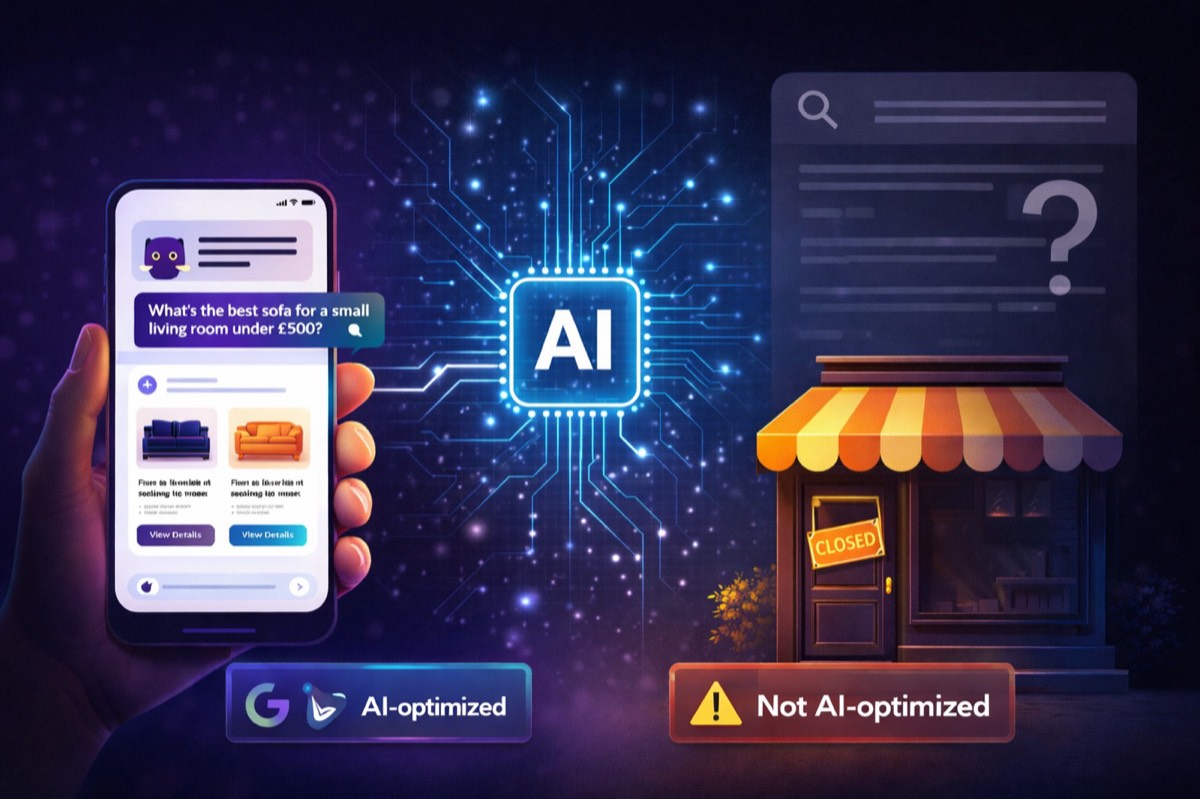
The Risk for Smaller Ecommerce Brands
Smaller businesses often rely on organic traffic to compete with larger retailers. Historically, strong SEO, niche positioning, and quality products were enough to win visibility.
AI introduces a new layer.
If your content is not structured clearly, if your brand is not referenced across trusted sources, or if your product information is not easily understood by AI systems, you may simply not appear in responses at all.
This does not mean small businesses are being pushed out overnight. But it does mean the margin for error is shrinking. Visibility is becoming more selective.
“AI is not replacing small businesses. It is replacing unclear, unstructured, and unhelpful content.”
The way people search, discover, and buy products online is changing faster than ever. Traditional search engines are no longer the only gateway to ecommerce. AI-driven tools, conversational search, and large language models are now influencing how customers find products, compare options, and make decisions.
For large brands with resources to invest in optimisation, this shift presents opportunity. For smaller businesses, it raises a more difficult question. Does the rise of AI in ecommerce create an uneven playing field, and could it push unprepared businesses out of the market?
The Shift From Search to Conversation
Search is no longer just about keywords and rankings. Users are now asking full questions, expecting direct answers, and relying on AI to guide their purchasing decisions.
Instead of browsing multiple websites, a customer might ask: “What’s the best sofa for a small living room under £500?”
AI tools can summarise options instantly, often pulling from a limited pool of sources. This changes visibility. It is no longer just about being on page one, it is about being selected as a trusted answer.
For businesses that have not adapted their content for this style of search, visibility can drop without any clear warning.
Does AI Put Small Businesses at Risk?
The short answer is no, but it does change the rules.
AI does not favour businesses based purely on size. It favours clarity, authority, and usefulness. In many cases, smaller brands are actually better positioned to provide detailed, focused content that directly answers customer needs.
The real risk comes from inaction.
Businesses that continue to rely on outdated SEO tactics, thin product descriptions, or unstructured content may gradually lose visibility as AI-driven systems prioritise more useful sources.
This is not an instant drop-off. It is a slow shift that compounds over time.